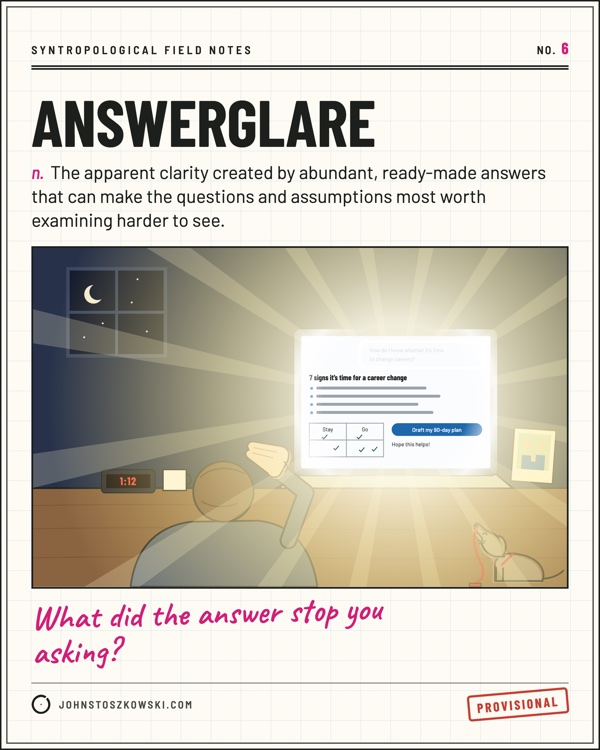
n.The version of you that never gets a chance to form, because predictions built from what you’ve already liked keep deciding what reaches you next.
What haven’t you been offered yet?
johnstoszkowski.comProvisional
The note
Right about your past
Recommendation has got very good. Spotify learns your musical tastes, YouTube learns your interests, and the next thing arrives already chosen, usually rather well.
What interests me is the possibility that personalisation can quietly become a form of confinement. Not because it gets you wrong, but because it gets you right.
Our preferences aren’t necessarily fixed properties waiting to be discovered. They can develop through unfamiliar encounters. You might never have become interested in jazz if somebody hadn’t played you something you initially found rather strange.
So the question isn’t simply whether algorithms understand us accurately. It’s whether their accuracy about our past can begin shaping our future.
It isn’t that you turned that other self down. It just never came up.
An everyday example
The record you’d never have picked
Think of something you love now that you didn’t choose. A band an older cousin played in the car. A writer a teacher wouldn’t stop going on about. A dish you only tried because it was what was on the table.
At first it was probably strange, maybe a bit much. Somebody else’s enthusiasm carried you through the first few goes, and somewhere along the way it became yours.
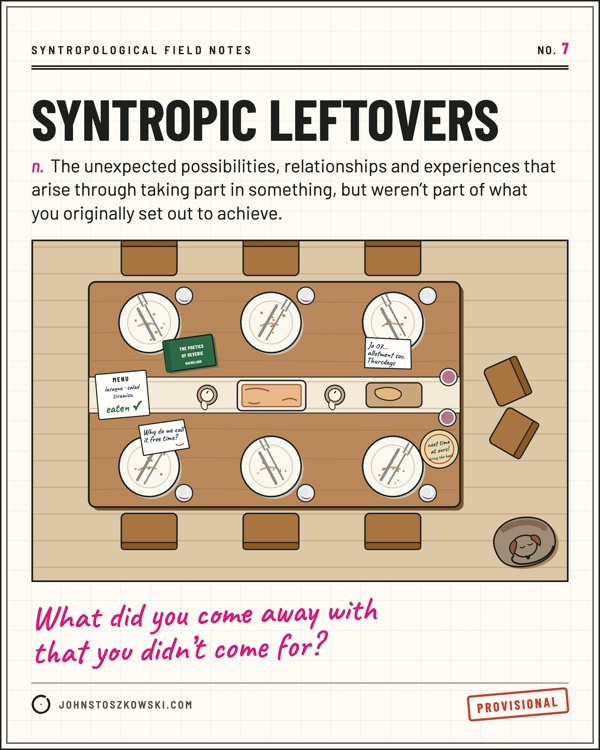
A recommendation engine can’t easily do that for you. It works by finding what’s near what you already like. The cousin’s car stereo worked the other way round: it was near what they liked.
Predicting a preference you already have and taking part in forming one you haven’t got yet aren’t the same thing, even when they arrive through the same speaker.
Something to try
Follow the feed
Pick where you’d start, then let the feed do its job. Watch the map: the dot is you, and the circle is how much of everything still reaches you.
The map of everything you could listen to
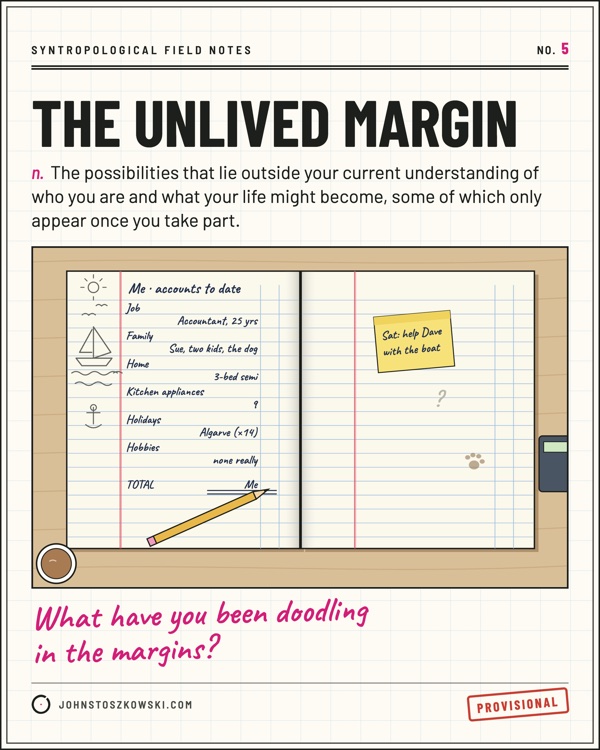
Was the taste there all along, waiting, or did three listens make it? That’s the question at the heart of the Unlived Margin.
What the listening shows
In 2020 a team at Spotify, led by Ashton Anderson, looked at how varied people’s listening was. Listening that came through recommendations went with narrower taste. And the people whose listening broadened over time did it by moving away from recommendations, towards finding things for themselves.
There’s an older finding underneath the jazz story too. In 1968 Robert Zajonc showed people unfamiliar things, among them made-up words and characters from a script they couldn’t read, different numbers of times. The more often they’d seen something, the more they tended to like it. Which is roughly what three goes of a strange record does.
The studies
Anderson, A., Maystre, L., Anderson, I., Mehrotra, R., & Lalmas, M. (2020). Algorithmic effects on the diversity of consumption on Spotify. Proceedings of The Web Conference 2020, 2155–2165. doi.org/10.1145/3366423.3380281
Zajonc, R. B. (1968). Attitudinal effects of mere exposure. Journal of Personality and Social Psychology, 9(2, Pt. 2), 1–27. doi.org/10.1037/h0025848
Not to be confused with
Similar species
A few near neighbours, and how to tell them apart in the field.
A filter bubbleEli Pariser’s name for being shown only what agrees with you. That’s mostly about news and opinion. This is about taste, and it isn’t that you only hear agreement: you only hear yourself.
TypecastingBeing given the same part because you were good in it last time. Here the casting director is your own history.
A comfort zoneSomewhere you choose to stay because it’s easier. A feed builds the room for you, then keeps redecorating it in the same style.
A self-fulfilling prophecyA prediction that makes itself come true. Close, but this prediction is really a summary of your past, pointed forwards.
Earlier sightings
Who spotted it before me
Jakob von Uexküll A Foray into the Worlds of Animals and Humans, 1934
Uexküll showed that every creature lives in its own Umwelt: the world of the things that mean something to it. A tick’s has three. A feed, I think, builds you an Umwelt out of everything you’ve already responded to, and then keeps it very tidy.
Deleuze thought new things come from encounters rather than from more of the same. He has a lovely line about learning: “We learn nothing from those who say: ‘Do as I do’. Our only teachers are those who tell us to ‘do with me’.”
A recommendation says: more like you. A neighbour with a record says: listen with me.
Gilbert Simondon Individuation, 1958
Simondon thought of a person less as a finished thing than as an individuation still under way, like a crystal growing in a solution. On his view you carry a reserve of potential that hasn’t yet become anything in particular, and it’s through meeting what’s outside you that more of it takes shape.
Predict someone from the individual they’ve already become, and you’re working from the finished part of something that isn’t finished.
Where it gets complicated
It was always somebody else
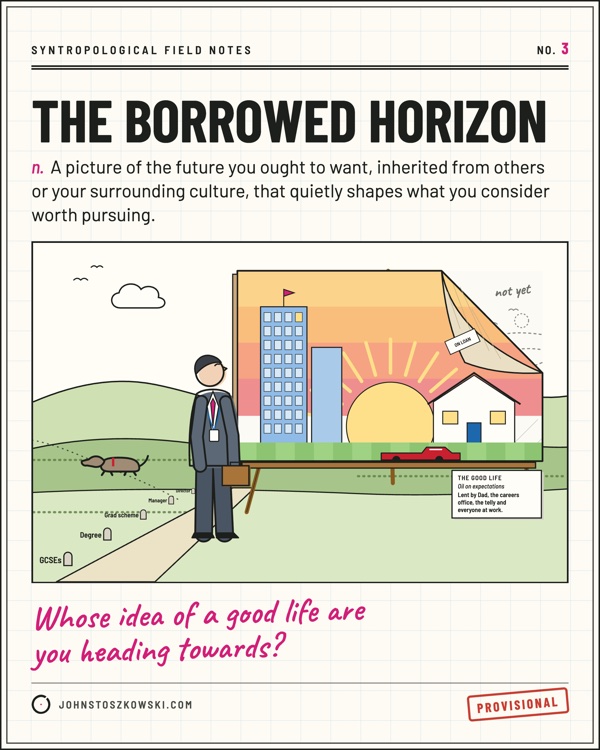
René Girard would want a word here. On his view our desires have always been shaped by things outside us: we want what our models want. The older cousin, the teacher, the friend whose taste you secretly envied. Nobody ever chose their preferences from a clean slate. (He turns up in the Borrowed Horizon too.)
So algorithms aren’t necessarily introducing a new phenomenon. They may be changing its mechanism and its scale. The cousin had taste of their own, a long way from yours, and could surprise you. The new model is a model of you.
And the opposite happens too. Plenty of people use recommendations to wander, and some feeds go out of their way to suggest something odd. The trouble starts when prediction becomes the only way anything new reaches you.
What happens to the tastes you’d only have grown into if somebody had insisted?
The difficult questionIf nearly everything you’re offered is chosen to match who you’ve been, where does who you might become get a look in?
One of a pair
Its other half
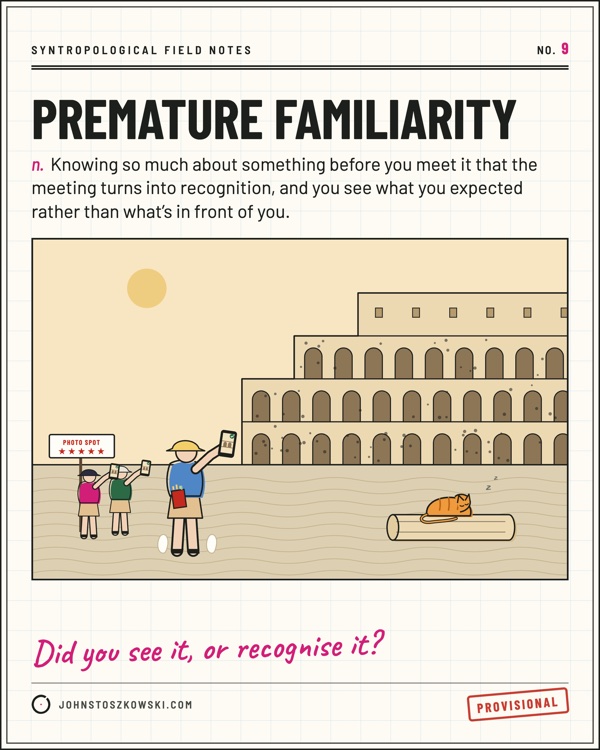
This note has a twin, Premature Familiarity. Read together, they’re about the same worry from two sides.
The unfamiliar gets filtered through what you’ve already seen of it
What might be lost
Interests you’d have grown into
Meeting something on its own terms
The question
What might I come to love?
What might I notice if I didn’t know what to expect?
Both question the idea that knowing more about ourselves, or about the world, automatically makes life richer.
Admit oneOpen-air cinemaComing soon
A short film
There’ll be a film of this one, three or four minutes long. When it’s done it’ll play here and in the open-air cinema.
Provisional
Field status
Open to correction
This is a working concept, a way of describing an experience that deserves closer attention. It might survive further investigation, it might need refining, or it might turn out to be better explained by a philosopher who’s been dead for two hundred years. That’s part of the enjoyment.
If you think I’ve got it wrong, or something you’d never have picked has become yours, I’d like to hear about it.