n.Knowing so much about something before you meet it that the meeting turns into recognition, and you see what you expected rather than what’s in front of you.
Did you see it, or recognise it?
johnstoszkowski.comProvisional
The note
Recognising isn’t meeting
Imagine visiting Rome for the first time. You’ve already watched dozens of videos, walked the streets online, read the reviews and seen hundreds of photographs.
When you arrive, you recognise everything. You know where to stand for the photograph. You know what the restaurant is famous for. You know which sights are supposedly unmissable.
But have you gained something or lost something? Probably both.
What interests me is that recognition and encounter aren’t the same thing. Knowing what to expect can deepen an experience. But familiarity can also tempt us to substitute recognition for attention, so we see what we already know is there rather than discovering what’s actually in front of us.
There’s familiarity that prepares you to meet something more deeply, and familiarity that makes the meeting feel over before it’s begun.
An everyday example
The painting off the fridge magnet
You finally stand in front of a painting you’ve known all your life from postcards, tea towels and fridge magnets. There it is. You check it’s the size you thought, take a photo of it, and move on feeling a bit flat. You’ve confirmed it rather than looked at it.
Then you notice the painting next to it, which nobody’s photographing, and you stand in front of that one for ten minutes.
The famous one wasn’t any worse. You’d just finished seeing it years ago.
Something to try
A day in Rome
You’re off next month. Decide what you’d do before you go, then see how the day turns out.
The camera, and the spoiler
In 2014 Linda Henkel took people round a museum and had them photograph some objects and simply look at others. The next day they remembered fewer of the objects they’d photographed, and less about them, unless they’d zoomed in on one detail. Then the effect went away.
Spoilers are less clear-cut. A much-cited 2011 study by Jonathan Leavitt and Nicholas Christenfeld found people enjoyed short stories slightly more when the ending had been given away. A 2015 study by Benjamin Johnson and Judith Rosenbaum, using longer stories, found the opposite. Knowing in advance seems to help some experiences and spoil others, which is rather the point of this note.
The studies
Henkel, L. A. (2014). Point-and-shoot memories: The influence of taking photos on memory for a museum tour. Psychological Science, 25(2), 396–402. doi.org/10.1177/0956797613504438
Leavitt, J. D., & Christenfeld, N. J. S. (2011). Story spoilers don’t spoil stories. Psychological Science, 22(9), 1152–1154. doi.org/10.1177/0956797611417007
Johnson, B. K., & Rosenbaum, J. E. (2015). Spoiler alert: Consequences of narrative spoilers for dimensions of enjoyment, appreciation, and transportation. Communication Research, 42(8), 1068–1088. doi.org/10.1177/0093650214564051
Not to be confused with
Similar species
A few near neighbours, and how to tell them apart in the field.
SpoilersKnowing how a story ends. This is wider: Rome doesn’t have an ending, and you can still have seen it before you get there.
The tourist gazeJohn Urry’s name for the way tourists look for what they’ve been taught to look for. Very close. This note is about what that does to the moment you arrive.
Déjà vuThe feeling you’ve been somewhere before when you haven’t. Premature familiarity is the opposite trick: you really have been there before, on a screen.
HabituationGetting used to something by meeting it again and again. Here you get used to it before you’ve met it once.
Earlier sightings
Who spotted it before me
Martin Heidegger Being and Time, 1927
Heidegger’s account of everyday understanding fits well. Much of what we know, we know the way “one” knows it: from what gets said. He calls it idle talk, and he means it more as a description than an insult. “Idle talk is the possibility of understanding everything without previously making the thing one’s own.”
Which is a fair description of arriving in Rome already knowing it.
Hans-Georg Gadamer Truth and Method, 1960
Gadamer thought real experience always leaves you open to more of it. “The truth of experience always implies an orientation toward new experience.” For him the experienced person isn’t the one who’s seen it all, but the one best equipped for new experiences.
Premature familiarity runs the other way: the more you’ve seen, the less there is left to happen.
Gaston Bachelard The Poetics of Space, 1958
Bachelard was a philosopher of wonder, and he thought you could get it back by looking closer. “The man with the magnifying glass takes the world as though it were quite new to him.”
Henkel’s museum visitors found something similar: zoom in on one detail, and the camera stops getting in the way.
Where it gets complicated
Knowing helps too
Knowing what to expect can deepen an experience. A musician may get far more from a symphony because they’ve studied the score. Read a little history, and a wall full of holes becomes a story about the Middle Ages and the price of iron.
So the problem isn’t knowledge. It’s knowledge that arrives as a checklist, where the job of the visit is to confirm what you already know. The musician studies the score to hear more of it when it’s played. A top ten exists to be ticked off.
Bachelard complicates it further. He once wrote that “to verify images kills them, and it is always more enriching to imagine than to experience.” Sometimes the version in your head is the better one, and arriving can only let it down.
What might you notice if you didn’t already know what to expect?
The difficult questionWhen does knowing what to expect help you see more, and when does it mean you’ve stopped looking?
One of a pair
Its other half
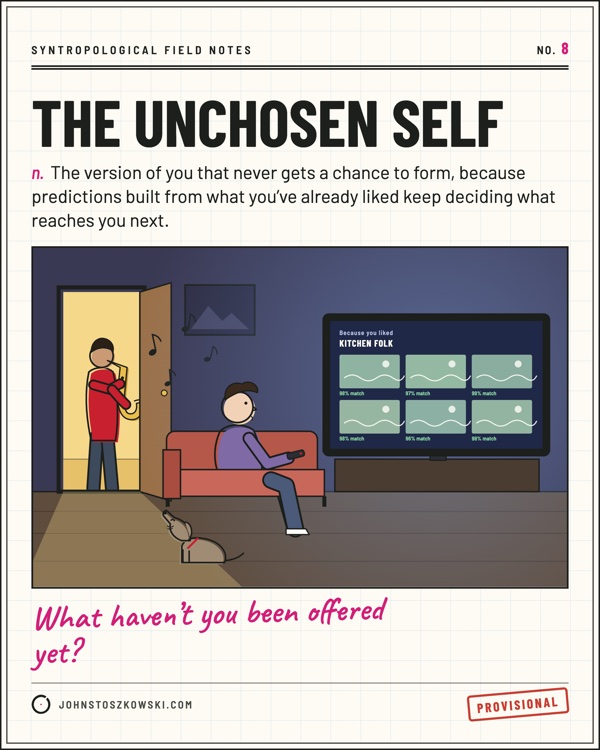
This note has a twin, The Unchosen Self. Read together, they’re about the same worry from two sides.
The unfamiliar gets filtered through what you’ve already seen of it
What might be lost
Interests you’d have grown into
Meeting something on its own terms
The question
What might I come to love?
What might I notice if I didn’t know what to expect?
Both question the idea that knowing more about ourselves, or about the world, automatically makes life richer.
Admit oneOpen-air cinemaComing soon
A short film
There’ll be a film of this one, three or four minutes long. When it’s done it’ll play here and in the open-air cinema.
Provisional
Field status
Open to correction
This is a working concept, a way of describing an experience that deserves closer attention. It might survive further investigation, it might need refining, or it might turn out to be better explained by a philosopher who’s been dead for two hundred years. That’s part of the enjoyment.
If you think I’ve got it wrong, or somewhere you knew by heart surprised you anyway, I’d like to hear about it.