n.The unexpected possibilities, relationships and experiences that arise through taking part in something, but weren’t part of what you originally set out to achieve.
What did you come away with that you didn’t come for?
johnstoszkowski.comProvisional
The note
What’s left when you’ve finished
When you take part in something worthwhile, something can emerge beyond its intended result: an unexpected friendship, a new question, a changed understanding, an unforeseen direction.
That extra isn’t merely a bonus on top of the original goal. Sometimes it becomes the most significant thing that happened.
Here’s the syntropological part. Taking part can generate possibilities that weren’t available before you took part. The world hasn’t simply handed you what you came for. Something has become possible that neither you nor the situation contained beforehand, at least not in quite that form.
I like the ordinariness of calling them leftovers. It doesn’t sound like a concept invented to impress anybody.
And there’s some humour in it: a few of the richest things life gives us are what remain after we’ve finished doing whatever we thought we were doing.
An everyday example
A dinner party
Imagine going to a dinner party. You go because you’ve been invited, you’re hungry, and someone’s promised to cook something nice. You have a good meal.
But you also meet somebody who introduces you to a book you’ve never heard of. You end up talking for an hour about something completely unexpected. A few weeks later, you’re reading that book. Six months later, you’re exploring an entirely new area of thought.
The dinner achieved its purpose. And perhaps the unplanned part ends up mattering far more than the meal. That’s a syntropic leftover.
Something to try
Clear the table
Everyone’s gone home. Dinner did what dinner was for. Clear the plates and see what was left.
Tap a plate to clear it
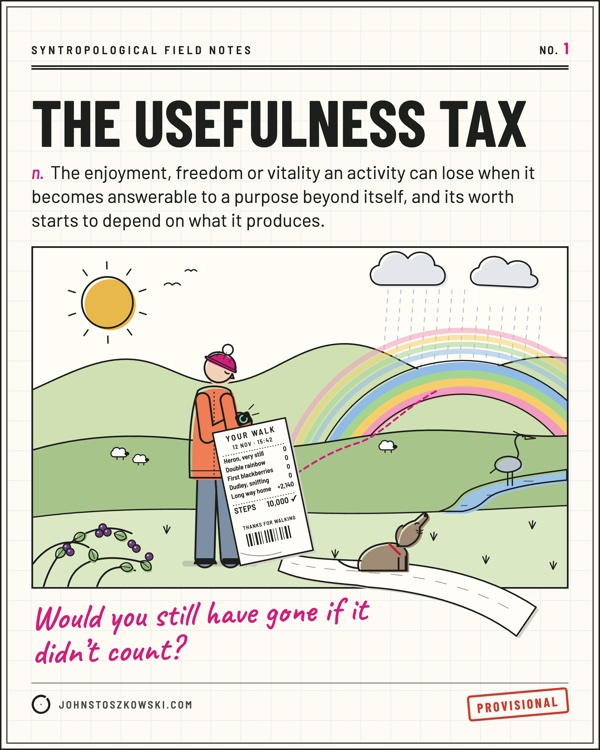
Go to dinner to collect leftovers and it’s become an investment. And then we’re back to the Usefulness Tax.
Not to be confused with
Similar species
A few near neighbours, and how to tell them apart in the field.
SerendipityA happy accident, a find you weren’t looking for. Leftovers need something more than luck: you had to be there, taking part, for an hour longer than you meant to.
Unintended consequencesAnything that happens that you didn’t plan, which might be damaging, irrelevant or merely accidental. A syntropic leftover is the kind that opens further possibilities for life, thought or relationship.
A bonusExtra value on top of the thing you came for. Leftovers aren’t extras you’re owed, and sometimes they turn out to be the main thing.
NetworkingGoing to dinner in order to come away with useful contacts. That’s an investment, and it tends to produce exactly what it set out to produce.
Earlier sightings
Who spotted it before me
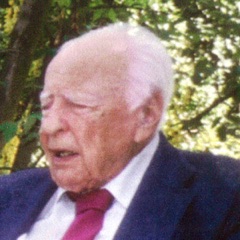
Hans-Georg Gadamer Truth and Method, 1960
In Truth and Method, Gadamer challenges the idea that the significance of an experience can be reduced to the intentions of the people involved. When we’re genuinely drawn into play, conversation or an encounter with art, something can unfold that exceeds what anyone intended or controlled. “The players are not the subjects of play; instead play merely reaches presentation through the players.”
He has a line that could be the motto of this note: “Every experience worthy of the name thwarts an expectation.”
Eugen Fink Oasis of Happiness, 1957
Fink’s philosophy of play adds another dimension: an activity can be meaningful in itself rather than needing its justification in something outside it. “The activity of play has only internal purposes, not ones that transcend it.”
Which is why leftovers can’t be the reason you go. The dinner has to be worth going to for its own sake.
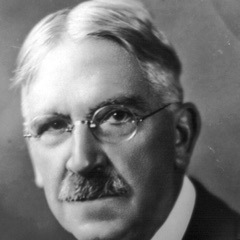
John Dewey Art as Experience, 1934
Dewey emphasised experience as an ongoing interaction between a living creature and its surroundings. He wrote that “life goes on in an environment; not merely in it but because of it, through interaction with it.”
On that view, a dinner isn’t a container you walk into and out of with what you came for. It’s an interaction, and interactions make things neither side brought along.
Where it gets complicated
The moment you go looking for them
If we start going to dinner parties, reading philosophy or playing games because we hope to generate valuable leftovers, we’ve turned those activities into another kind of investment. And then we’re back to the Usefulness Tax.
Syntropic leftovers are what can emerge when you’re fully involved in something. They aren’t rewards you’re entitled to collect afterwards.
Which leaves a slightly awkward question hanging. Now that you know about them, can you still go to dinner without keeping an eye out? The moment we start trying to maximise our syntropic leftovers, have we missed the point?
What if some of the most interesting things in life aren’t the things we set out to get, but the things that become possible because we took part?
The difficult questionIf we measure an activity only by what it was supposed to achieve, how much of what actually mattered might go unnoticed?
Admit oneOpen-air cinemaComing soon
A short film
There’ll be a film of this one, three or four minutes long. When it’s done it’ll play here and in the open-air cinema.
Provisional
Field status
Open to correction
This is a working concept, a way of describing an experience that deserves closer attention. It might survive further investigation, it might need refining, or it might turn out to be better explained by a philosopher who’s been dead for two hundred years. That’s part of the enjoyment.
If you think I’ve got it wrong, or something you didn’t come for has turned out to matter, I’d like to hear about it.