n.The possibilities that lie outside your current understanding of who you are and what your life might become, some of which only appear once you take part.
What have you been doodling in the margins?
johnstoszkowski.comProvisional
The note
The life you know how to describe
The Unlived Margin isn’t simply the collection of paths you didn’t take.
That’s closer to counterfactual regret: imagining what your life might have been. Nor is it an infinite reserve of possibilities available to everybody. Our lives are finite. Bodies, money, relationships, responsibilities and circumstances genuinely constrain what’s possible.
The margin is the difference between the life you currently know how to describe and the possibilities that might still emerge within your circumstances. Sometimes it’s narrow. Sometimes it’s surprisingly wide.
And discovering another possibility doesn’t mean you should pursue it. Its existence can be interesting in itself.
An everyday example
Twenty-five years, and a boat
Picture somebody who’s been an accountant for twenty-five years. They’re good at it. They have a decent life, a family, friends and a perfectly respectable collection of kitchen appliances. Ask them who they are and they’ll probably mention their profession.
Then, one weekend, they help a friend restore an old boat. Something happens. They’re absorbed. Interested. Learning. Hours disappear. They discover an enthusiasm they hadn’t anticipated.
It doesn’t mean they’ve been living the wrong life. They don’t necessarily need to resign on Monday and buy a boat.
But they’ve encountered something that didn’t previously feature in their picture of themselves. A possibility that was there to be discovered, but wasn’t yet part of the life they knew how to imagine.
Something to try
Help Dave with the boat
Saturday, ten o’clock, Dave’s garage. Sand off the old paint. Dave says go with the grain, so drag along the planks.
Drag along the planks
It doesn’t mean you’ve been living the wrong life, and nobody needs to buy a boat on Monday. But something turned up that wasn’t in the description.
Most of us expect to stop changing
In 2013 Jordi Quoidbach, Daniel Gilbert and Timothy Wilson asked more than 19,000 people, aged 18 to 68, how much their personalities, values and preferences had changed over the past ten years, and how much they expected them to change over the next ten. At every age, people reported plenty of change behind them and expected much less ahead. The researchers called it the end of history illusion. Not everyone agrees on how to read it, but it’s a curious result: we seem to treat whoever we are now as the finished version.
Not to be confused with
Similar species
A few near neighbours, and how to tell them apart in the field.
The road not takenCounterfactual regret: picturing the life you might have had if you’d chosen differently. That looks backwards at paths you could already see. The margin holds possibilities you couldn’t have pictured at all.
The true selfThe idea that a fully formed, authentic you is hidden inside, waiting to be uncovered. The margin makes no such promise. What turns up there isn’t found so much as made, by taking part.
Possible selvesThe psychologists Hazel Markus and Paula Nurius’s name for the selves we imagine becoming, hope to become or fear becoming. Those can already be described. The margin is what lies outside even them.
Untapped potentialThe motivational poster version: you could be anything. You couldn’t. Bodies, money and other people are real. The margin is narrower than that, and more interesting.
Earlier sightings
Who spotted it before me
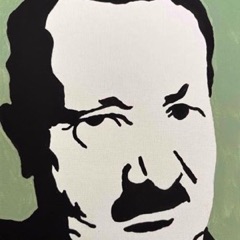
Martin Heidegger Being and Time, 1927
Heidegger is particularly useful here. In Being and Time, human existence isn’t understood simply as a collection of existing characteristics. We’re also beings who understand ourselves through possibilities. What we can become matters to what we are.
“In each case Dasein is its possibility, and it ‘has’ this possibility, but not just as a property.” An accountant isn’t an accountant the way a kettle is a kettle.
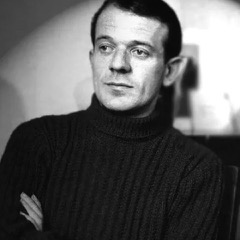
Gilles Deleuze Difference and Repetition, 1968
Deleuze offers another direction through his emphasis on becoming rather than fixed identity. For him, real thinking doesn’t start from what we already recognise. It starts with an encounter. “Something in the world forces us to think.”
A weekend sanding somebody else’s boat would count.
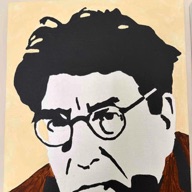
Ernst Bloch The Principle of Hope, 1954–59
Bloch’s not-yet gives us a way of thinking about the unfinished possibilities of both people and the world. He had a name for what dawns in us before we can say what it is: the Not-Yet-Conscious.
The enthusiasm in Dave’s garage was there before the accountant had a word for it. I made a short film about Bloch.
Something else to try
A small sentence doing a lot of work
People say it all the time, and it sounds innocent. Tap each part to see how much it’s carrying.
I’mPresent tense. As if the description were finished.
justSounds modest. It isn’t: it settles the matter before anything’s been tried.
notA verdict, usually reached without any evidence from the thing itself.
that sortAs if people came in sorts, like kitchen appliances.
of person.A whole self, decided from the inside. Which is the one place you can’t quite see it from.
I’m just not that sort of person.I haven’t been that sort of person. So far.
It might stay true. Some things genuinely aren’t for you, and money, bodies and time rule plenty out. But it’s a description of where you’ve been, not a survey of the margin. You only find out where that runs by taking part.
Where it gets complicated
Not a hidden self
The Unlived Margin shouldn’t mean there’s a fully formed, authentic person hidden inside you, waiting to be uncovered. That would bring us straight back to the language of finding your true self.
I’d suggest something more interesting. Some possibilities only become available through taking part in things you couldn’t have fully imagined beforehand. You couldn’t necessarily have planned the discovery, because you didn’t yet know what it would feel like.
Which is why the margin can’t be mapped from an armchair. You find out where its edges are by walking into it, and sometimes it turns out to be much narrower than you hoped.
What might become possible if you stopped treating your current description of yourself as a complete account?
The difficult questionHow much of what you believe is impossible is genuinely impossible, and how much simply lies outside the life you’ve learned to imagine?
Admit oneOpen-air cinemaComing soon
A short film
There’ll be a film of this one, three or four minutes long. When it’s done it’ll play here and in the open-air cinema.
Provisional
Field status
Open to correction
This is a working concept, a way of describing an experience that deserves closer attention. It might survive further investigation, it might need refining, or it might turn out to be better explained by a philosopher who’s been dead for two hundred years. That’s part of the enjoyment.
If you think I’ve got it wrong, or something’s turned up in your own margin lately, I’d like to hear about it.